
One Piece Worth Seeing
Edmond Brooks-Beckman, Dampened Voices, 2024

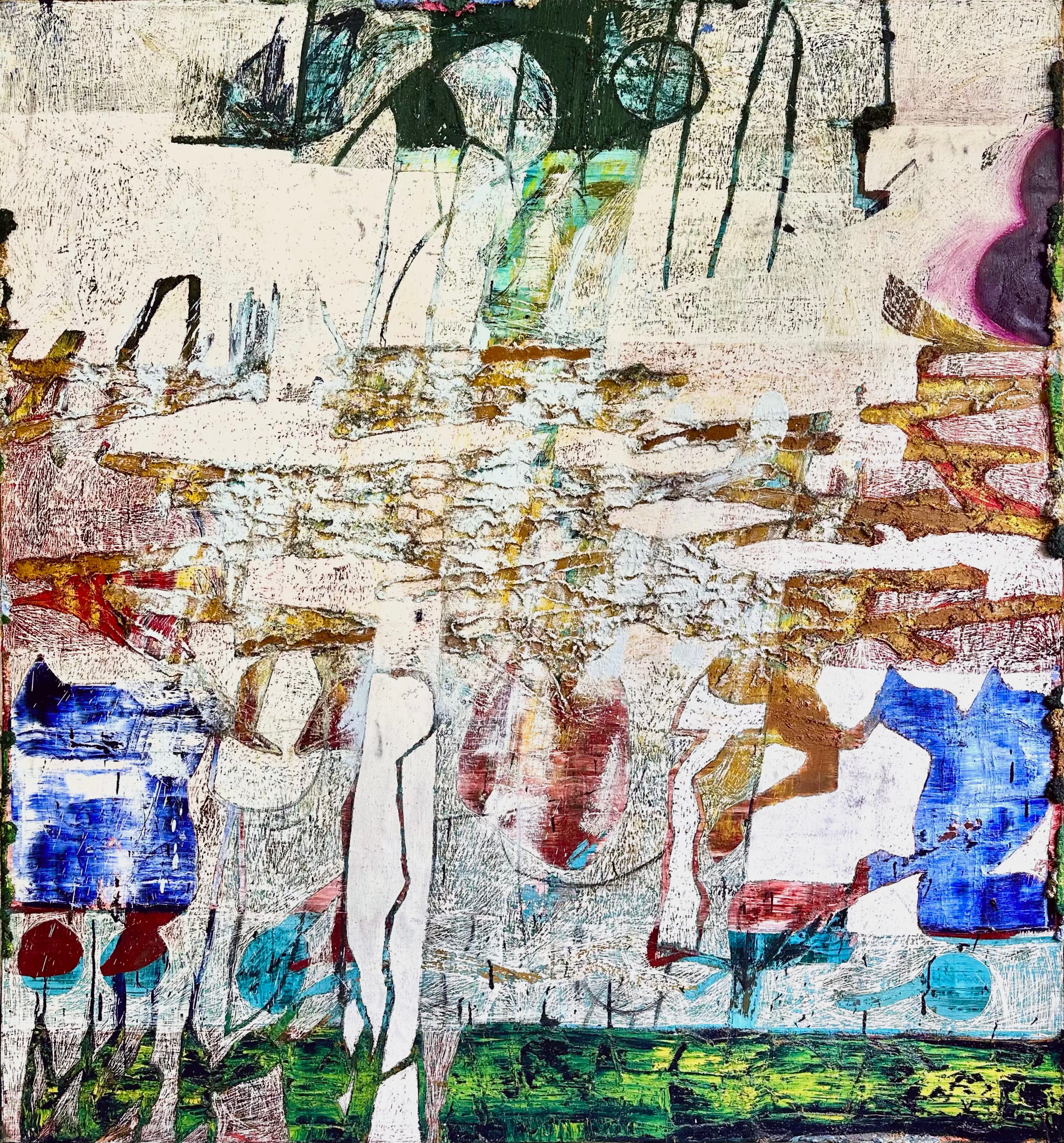
Painting usually involves accumulation… you put something down, then something over it, and continue until the picture arrives. Brooks-Beckman follows that logic for a while, then turns against it. He builds up layers of thick oil paint and carves back into them - gouging, scraping, dragging, burying one decision beneath another, then cutting through to recover fragments of what was there before. The surface of Dampened Voices is the result of that argument, and it’s not a settled one.
In reproduction you can read the broad structure: a pale expanse across the upper half, darker forms suspended above it, greens and blues gathering towards the base. In the flesh it is much stranger. Paint has accumulated into ridges, crusts and small overhangs. The central passage looks like mineral deposits or lichen spreading across a wall - chalky whites, ochres, bruised reds and flashes of green, one colour pressing through another. Parts of the surface seem to have grown rather than been painted. It’s thick enough to cast its own shadows and changes as you move around it.
There is also something unexpectedly fragile about it. Brooks-Beckman is not precious about what he has made. When paint lifts, cracks or shakes loose, he doesn’t repair it. A fragment falling away is not treated as damage to an immaculate object. It becomes another event in the painting’s life. The work is allowed to shed, and that shedding becomes part of its meaning.
This is important because the painting never feels like a display of technique. Its physicality is not there simply to impress. The scraping and cutting create a sense of memory under strain, of one image trying to survive inside another. Earlier decisions remain visible at the edges of later ones. Marks are muffled, partly buried, sometimes reduced to stains or interruptions, but they are never entirely gone.
The imagery behaves in the same way. Something like a landscape appears - a low horizon, possible trees, pale figures in the middle distance, a violet curve pressing in from the right like a curtain, a body or the edge of another scene. None of these readings fully settles. Each arrives briefly and then recedes into the surface.
Brooks-Beckman’s paintings often carry personal, cultural and historical material, without resolving any of it into illustration. The work does not tell us what to see. It allows meaning to surface gradually, then withdraw. That restraint gives Dampened Voices much of its force. It has the atmosphere of something remembered imperfectly, or heard through a wall.
The title is worthwhile. These are not absent voices, but dampened ones - sounds that have been muffled, absorbed into something thicker. Earlier decisions keep pressing through even when they have mostly been covered. The painting holds what has happened to it. That is where Brooks-Beckman’s work becomes so compelling. It is dense where you expect resolution and open where you expect density. It resists elegance without tipping into brute materiality. Painting and damaging have become versions of the same act, leaving a surface that feels ancient, unstable and still alive to the next decision.