
One Piece Worth Seeing
Justin Mortimer, Work on Paper, 2024-26

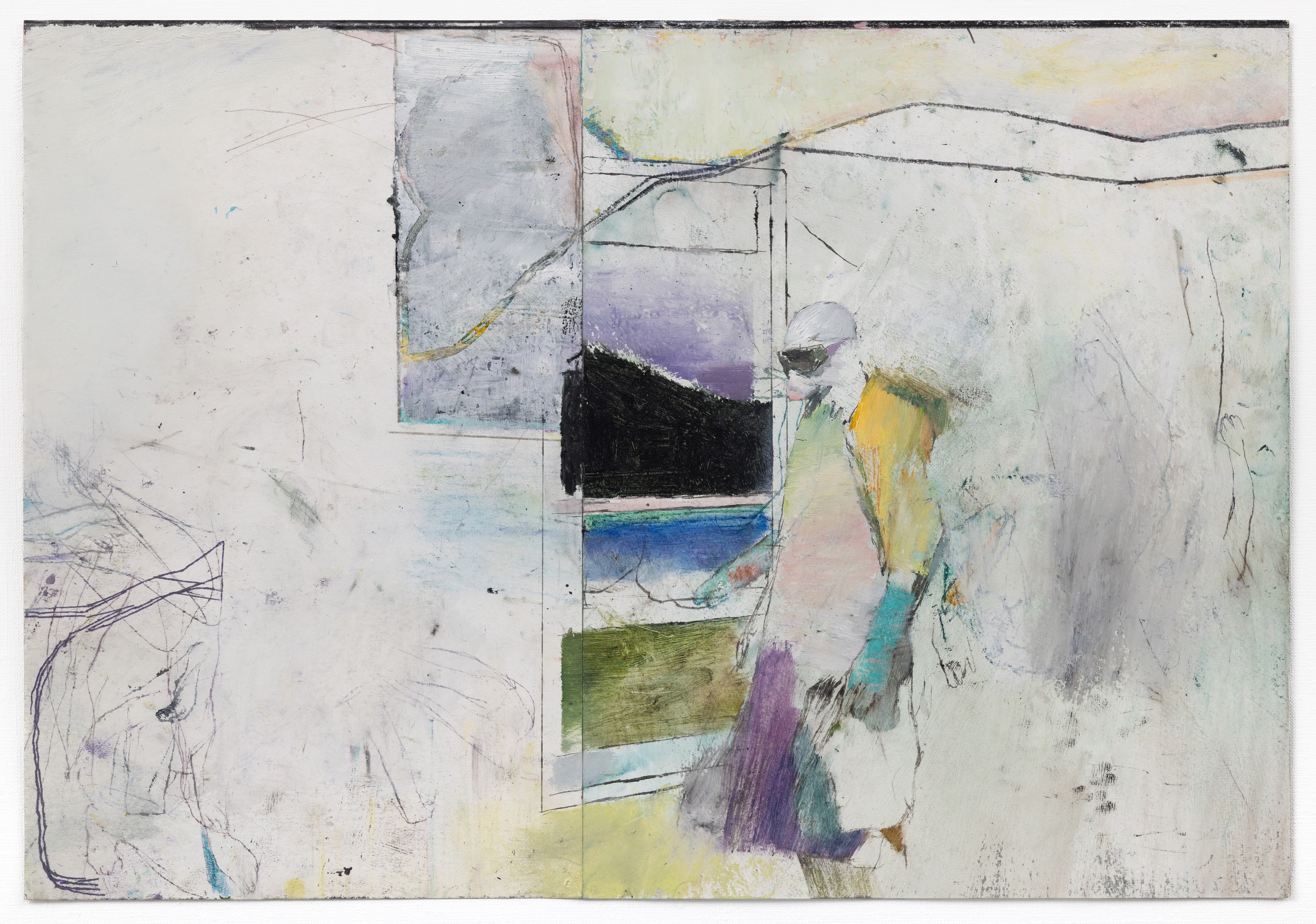
This week I wanted to look at a work on paper by Justin Mortimer because it shows something essential about the way he thinks as a painter. Mortimer is one of the most technically gifted artists I have known, but the interesting thing is not simply the skill. It is what he does with it. Or perhaps more accurately, what he refuses to let it become.
He is a painter who can make an image appear with unsettling speed and precision, then scrape it away because it has become too easy, too complete, too pleased with itself. That habit - making, unmaking, repairing, washing out, replacing - runs through his paintings, but in the works on paper it is especially exposed. The paper does not hide the process. It keeps the evidence.
Work on Paper, 2024-26 is made in oil, pastel and charcoal across two sheets. At 39 by 56 cm, it is modest in scale, but not modest in ambition. The image appears to have been built, interrupted and rebuilt several times. On the left, the surface is almost empty, but full of incident: faint scratches, ghost marks, little residues of thought. In the centre, rectangles suggest a window, a screen, a memory, an image within an image. A black block sits among pale blues, greens and violets like something censored, burnt out or withheld. To the right, a figure begins to emerge - yellow, green-blue, purple, flesh-coloured - then refuses to settle into a stable body.
That instability is very Mortimer. His work is figurative, but never comfortably so. Bodies appear half-seen, partly erased, broken by screens, veils, architectural fragments or areas of interference. The scene is usually after something, or before something, but rarely during the thing itself. He is not a painter of incident. He is a painter of residue.
Mortimer first came to attention very young, winning the BP Portrait Award in 1991. He could easily have become a very different kind of artist: a painter of likeness, status and public recognition. He did, in fact, receive major portrait commissions. But that was not where the deeper work was. Over time he moved away from the polished authority of portraiture and towards something far stranger: damaged images, dislocated figures, social unease, implied violence, the human body as something fragile, exposed and provisional.
The Bosnian war is often mentioned in relation to this shift, and rightly so. Mortimer has spoken about its importance as an early trigger for the work he began making afterwards. But it would be too simple to describe him as a painter of war or trauma. His paintings are not illustrations of crisis. They are more ambiguous than that, and more interesting. They seem to ask what happens to vision after the fact. What remains in the mind once the event itself has moved on? What kind of image is left when certainty has been damaged?
For several years, my studio was below his. I would go upstairs, talk to him, look at whatever he was working on, then leave to collect something or make coffee. An hour later I might go back and find that a small figure had appeared. I remember one in particular: a young man with bare legs. Somehow, with only a few marks, Mortimer had made those legs look hairier than any painted legs had a right to look. I stood there trying to work out how he had done it. There was no visible trick, no laborious descriptive build-up, no showing off. Just a few exact decisions. Then, almost inevitably, he scraped it off.
That stayed with me because it seemed to reveal something important about him. Many painters would have protected that passage. They would have made the rest of the painting justify it. Mortimer seemed almost suspicious of it. The fact that it worked was not enough. Perhaps it worked too easily. Perhaps it belonged to the wrong painting. Perhaps it had become too much like evidence of skill.
This is where his work becomes most compelling. He is not an artist struggling to render the figure. He is an artist who can render it beautifully and then has to decide whether that beauty is useful, truthful or dangerous. The scraping back is not vandalism. It is judgement.
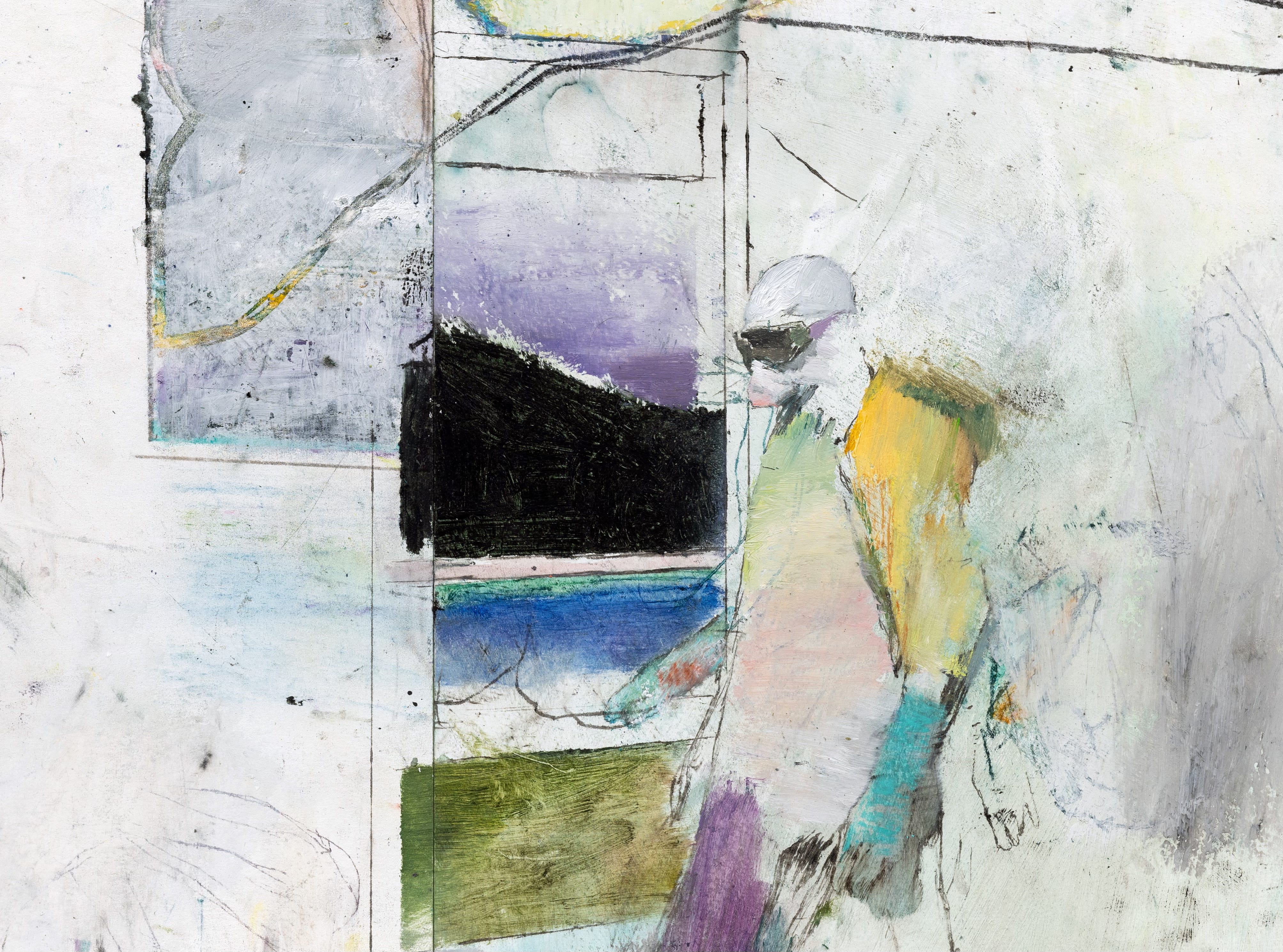
You can see that judgement in this work. The figure on the right is present, but not secured. The yellow form might be a shoulder, a garment, a screen of light or a piece of displaced image. The green-blue passage reads as an arm, but only just. The purple below suggests weight or shadow, perhaps a leg, perhaps nothing so fixed. Mortimer gives enough for the body to begin, then withdraws enough to keep it from becoming explanatory.
The join between the two sheets is important too. It is not disguised. It cuts through the work like a structural hesitation. Mortimer often builds paintings from collaged source material - photographs, scans, found images, fragments pulled from different places - and here that way of thinking becomes physical. The image is not one continuous field. It is assembled, interrupted and made to live with its own discontinuity.
That may be why these works on paper feel so alive. They are not studies in the secondary sense. They are not preparatory notes waiting for the authority of canvas. They are places where Mortimer’s thinking remains visible. The image has not been sealed up. The revisions have not been tidied away. You can feel the work searching for the point at which a figure, a place or a memory becomes legible - and then stopping just before it becomes too legible.
There is also an unexpected delicacy here. Mortimer is often associated with darkness, and for good reason. His paintings can carry a very particular kind of dread. But this work is pale, rubbed, almost bleached. Its emotional force comes less from theatrical darkness than from exposure. The empty spaces are not neutral. They feel tested, used, cleared and re-used. The image seems to have survived its own making.
That is why I like it. It contains the intelligence of a painter who knows exactly how to make things convincing, but does not trust conviction on its own. It is thoughtful, searching, damaged, tender and unresolved in the right way. It does not ask to be admired for finish. It asks to be looked at for evidence - of decisions made, doubted, reversed and partly recovered. Mortimer’s authority lies in that tension. He knows how to make the legs look hairy. Then he scrapes them away.
I remember seeing his work in the art magazines back when he had a show at Haunch of Venison. I only remember that because of the weirdness of the gallery name. I certainly don't remember when. But the images from that show were so haunting, much like you've described. Your descriptions bring it all back. I loved the darkness and unease. The green balloons and strewn bodies, and trash. He struck me as a master of despair. I have wished so many times I had ordered the catalog.
Thanks for your writing on this piece. The focus on the decisions an artist makes is refreshing because who knows these things but an artist? Who has asked these questions and fought and worked through them but the artist? Oh the doubt and loneliness of the artist with these questions. And then to contend with the voices of the gallery who never in my experience ever ask these questions. This has struck a nerve, so I'll leave that. But how beautiful for you to acknowledge this piece and it's many questions. It takes a knowing artist, and you've presented it so well.
Brilliant, thanks. Both your writing and his work.